Landlord Safety Responsibilities in Liverpool: A 2026 Compliance Guide

Updated: Jul 31
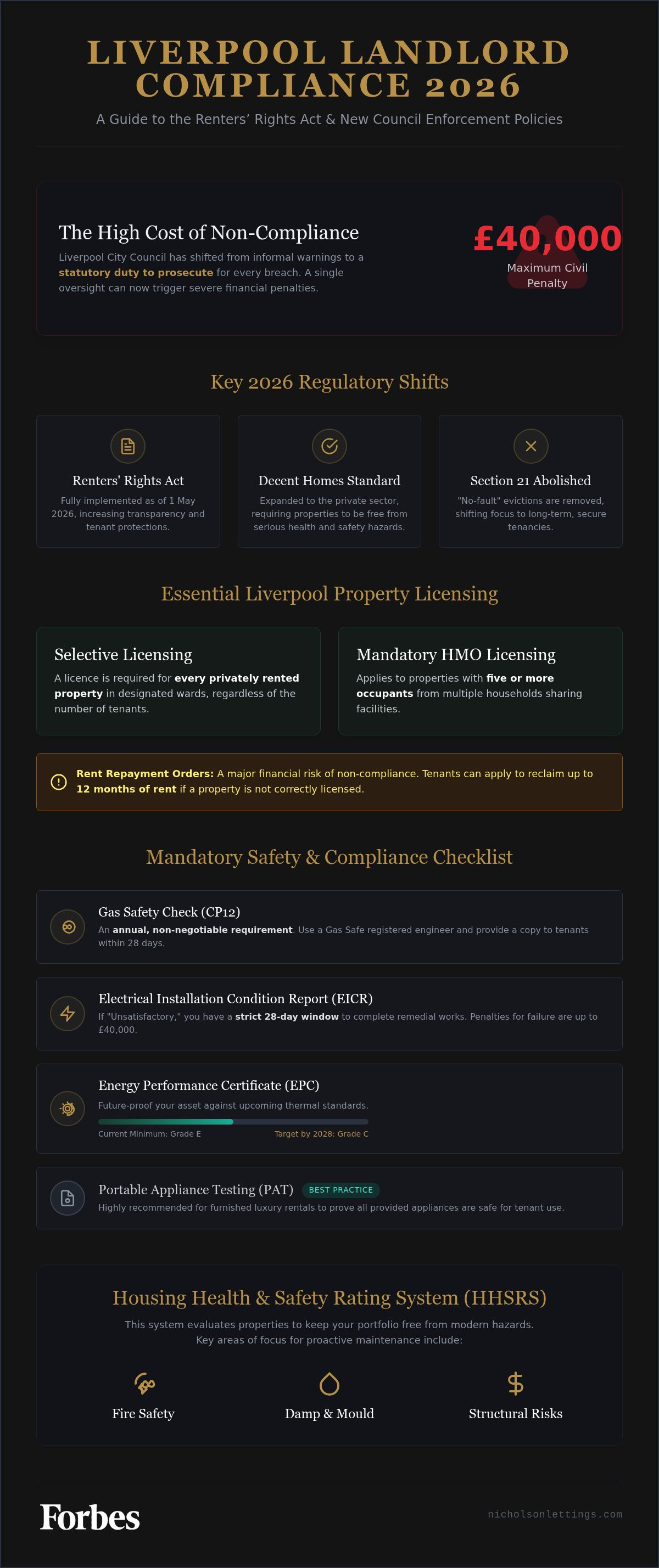
A single oversight in your electrical certification can now result in a civil penalty of up to £40,000 under Liverpool City Council’s latest enforcement policies. With the full implementation of the Renters’ Rights Act as of May 2026, the margin for error has vanished, making it vital to master your landlord safety responsibilities Liverpool. Managing property in the Liverpool City Region has become a high-stakes endeavour where informal warnings have been replaced by a statutory duty to prosecute.
We understand that the shift to mandatory periodic tenancies and the phased rollout of the National Landlord Database can feel like a logistical mountain. You want to provide a premium home for your tenants without the constant anxiety of shifting legal goalposts. This guide provides the absolute clarity you need to navigate these 2026 regulations, ensuring your portfolio remains both legally compliant and stress-free.
We will walk you through a definitive checklist of required safety certificates, explain the nuances of Liverpool’s selective licensing wards, and show you how a professional approach to maintenance can remove the burden of compliance entirely.
Table of Contents
The 2026 Regulatory Landscape for Liverpool Landlords
The regulatory environment in 2026 has fundamentally shifted how property owners must approach their landlord safety responsibilities Liverpool. With the Renters’ Rights Act now in full effect as of May 1, 2026, the landscape is defined by increased transparency and tighter enforcement. The abolition of Section 21 notices is the most publicised change, but the expansion of the Decent Homes Standard into the private rented sector carries more weight for daily operations. This standard requires every rental property in the Liverpool City Region to be free from serious health and safety hazards, placing a statutory emphasis on proactive maintenance.
Local enforcement across postcodes L1 to L38 has intensified. Liverpool City Council now operates under a statutory duty to consider formal enforcement action for every breach, moving away from the informal warnings of previous years. These modern requirements are built upon the foundation of the Landlord and Tenant Act 1985, which remains the primary legislation ensuring properties are fit for human habitation. For landlords, this means that a "wait and see" approach to repairs is no longer viable. Total compliance is the only way to protect your investment and your reputation.
Liverpool Selective Licensing and HMO Rules
Navigating the ward-specific rules in Liverpool is essential for legal operation. Selective Licensing requires a licence for every privately rented property in designated wards, regardless of the number of tenants. This is distinct from Mandatory HMO Licensing, which applies to properties with five or more occupants from multiple households. Failing to secure the correct licence is a costly error. In 2026, operating an unlicensed HMO can lead to a civil penalty of up to £40,000. Additionally, tenants can apply for Rent Repayment Orders to reclaim up to 12 months of rent, making non-compliance a significant financial risk.
If the mounting costs and risks of compliance are leading you to consider divesting, you can learn more about Auction Property Ltd to see how selling your property via auction can offer a swift and certain exit strategy.
The 2026 EPC Update: Moving Towards Grade C
Energy efficiency is now a core component of property safety and tenant retention. While the minimum requirement currently sits at Grade E, the government's push toward a Grade C target by 2028 has made early adoption a priority for luxury rentals in the North West. Upgrading insulation and heating systems helps future-proof your asset against upcoming thermal standards. Nicholson Lettings assists landlords by coordinating these upgrades through a dedicated maintenance team, ensuring that even complex period conversions in the city centre meet modern efficiency benchmarks. Various regional grants are currently available to support these energy improvements, reducing the direct cost of compliance.
Mandatory Safety Certifications and Inspections
Securing the right paperwork isn't just a legal formality; it's the backbone of a successful rental strategy. To protect your investment and your tenants, you must stay ahead of Mandatory Safety Certifications and Inspections. In Liverpool, where the council's enforcement stance has sharpened, missing a deadline can trigger financial penalties of up to £40,000 for electrical safety breaches alone. Managing these dates across multiple properties requires a rigorous system to ensure no certificate expires unnoticed.
Your landlord safety responsibilities Liverpool include three primary pillars: gas, electricity, and water. For those offering fully furnished luxury apartments, an additional layer of care involves Portable Appliance Testing (PAT). While not a strict legal requirement for every tenancy, PAT testing is considered best practice for high-end rentals to prove that every provided appliance, from the designer coffee machine to the integrated microwave, is safe for use. It's this level of attention to detail that separates professional landlords from the rest of the market.
Gas and Electrical Safety Protocols
Annual Gas Safety Checks (CP12) remain a non-negotiable statutory requirement. You must use a Gas Safe registered engineer to inspect every appliance and flue. Once the check is complete, a copy of the record must be provided to existing tenants within 28 days. Digital record keeping has become the industry standard in 2026. Relying on paper certificates is risky; digital copies are easier to track, share, and present during council audits. If your Electrical Installation Condition Report (EICR) returns an "Unsatisfactory" result, you have a strict 28-day window to complete remedial works. Failing to act quickly doesn't just risk a fine; it puts your tenants at immediate risk.
Legionella and Water Safety
Legionella risk assessments are often overlooked but remain a vital duty. For modern city centre apartments, a proportional assessment is usually sufficient. You don't always need a specialist consultant for a standard flat, but you must identify and control potential risks. Simple actions, such as advising tenants to flush taps after a long holiday or setting water cylinder temperatures to at least 60°C, are effective. If your property has complex water systems or cooling towers, a professional assessment becomes mandatory. Balancing these technical requirements can be exhausting, which is why many choose to let our dedicated maintenance services handle the logistics of recurring inspections.
Fire Safety and the Housing Health and Safety Rating System (HHSRS)
Fire safety is a pillar of the Liverpool rental market, particularly given the city’s architectural diversity. From the historic Georgian quarters to the sleek skyline of the Baltic Triangle, each property type presents unique risks. While previous sections focused on mandatory certifications, the Housing Health and Safety Rating System (HHSRS) demands a more holistic view of the living environment. This risk-based assessment tool allows local authorities to identify 29 different hazards, ranging from fire and structural collapse to more subtle issues like damp and mould.
Failing to address these hazards can lead to improvement notices or heavy fines. Staying current with a landlord's safety responsibilities means looking beyond fire alarms to the 29 potential hazards identified by the HHSRS. For those providing fully furnished luxury apartments, the Furniture and Furnishings (Fire Safety) Regulations are equally critical. You must ensure all upholstered items, including sofas, bed bases, and mattresses, carry the permanent fire safety labels. It's a small detail that carries significant legal weight in the event of a council inspection.
Smoke and Carbon Monoxide Compliance
The 2022 and 2026 updates have clarified expectations for every tenancy. You must install a smoke alarm on every habitable storey of the property. Carbon monoxide alarms are mandatory in any room containing a fixed combustion appliance, excluding gas cookers. For high-end L1 apartments, hard-wired alarms are the gold standard. They offer greater reliability and often integrate better with modern building management systems. Always test these devices on the day a new tenancy begins and keep a digital record of the result to prove compliance.
Managing HHSRS Hazards in High-End Properties
Luxury rentals are not immune to HHSRS hazards. Damp and mould are frequently flagged in older Liverpool conversions, often caused by poor ventilation or structural defects. Category 1 hazards, the most serious level, require immediate remediation to avoid council intervention. Proactive maintenance is the best defence. By implementing a rigorous inspection programme, you can spot minor issues before they escalate into health risks. This approach protects the aesthetic value of your property while fulfilling your landlord safety responsibilities Liverpool.
How to Organise a Compliance Calendar for Your Property
Efficiency in 2026 is built on foresight. With the Renters’ Rights Act now governing every tenancy, your schedule for meeting landlord safety responsibilities Liverpool must be bulletproof. A reactive approach to maintenance is a fast track to council penalties. You need a centralised compliance calendar that triggers alerts well before certificates expire. This system should account for annual gas safety checks, five-year electrical inspections, and the new requirements for the National Landlord Database registration, which is beginning its phased rollout in late 2026.
Centralising your records in a digital document vault is no longer optional. It's a necessity. When the council requests proof of compliance, you must be able to produce it instantly. This level of organisation ensures that property access is coordinated with tenants well in advance, respecting their right to quiet enjoyment while fulfilling your legal duties. If you find the logistical burden overwhelming, our dedicated maintenance services provide a streamlined way to manage these recurring obligations without the administrative headache.
The Pre-Tenancy Safety Audit
The transition between tenancies is your most critical window for safety verification. You must perform a comprehensive audit before a new tenant moves in. This includes verifying Right to Rent status and ensuring the latest version of the government’s "How to Rent" guide is provided. Handing over valid safety certificates at the start of a tenancy is a statutory requirement that protects your right to use the revised possession framework later. The role of a tenant liaison officer St Helens is invaluable here, acting as a bridge between technical compliance and tenant education to ensure a smooth start to the agreement.
Mid-Tenancy Vigilance
Safety doesn't end once the keys are handed over. Quarterly mid-term inspections are essential for preserving the condition of luxury properties and spotting emerging hazards. These visits allow you to identify tenant-induced risks that might otherwise go unnoticed. For instance, tenants occasionally cover vents to prevent drafts or disable smoke alarms while cooking. Spotting these issues early prevents them from becoming Category 1 hazards under the HHSRS. Clear reporting procedures for emergency repairs should be established from day one, ensuring that any structural or safety failures are addressed by professionals before they escalate into serious legal liabilities.
Mitigating Risk: Why Professional Management is the Ultimate Safety Net
The transition from an "accidental landlord" to a professional operator is no longer a choice. It's a requirement for survival in the 2026 market. Managing landlord safety responsibilities Liverpool requires more than just a basic spreadsheet; it demands a dedicated infrastructure. Professional property management serves as a vital buffer between you and the increasing scrutiny of local authorities. By delegating these duties, you transform a complex logistical burden into a streamlined, high-performing investment. You shift the weight of liability onto experts who live and breathe compliance every day.
Legal protection is the most significant advantage of a managed service. Professional agents act as your first line of defence, ensuring that every notice is served correctly and every inspection is logged. In an era where Liverpool City Council has a statutory duty to prosecute for breaches, having a robust audit trail is your best insurance policy. This allows you to focus on the high-level performance of your portfolio whilst a dedicated team handles the granular details of safety and maintenance. It is about moving from a state of constant vigilance to one of confident ownership.
Nicholson Lettings: Local Expertise in Action
We manage over 250 high-quality properties across the Liverpool City Region, providing a level of local expertise that remote agencies cannot match. Our comprehensive approach to property management is built on proactive intervention rather than reactive repair. We operate an in-house maintenance department that ensures rapid compliance and 24/7 safety coverage for your tenants. This infrastructure is particularly beneficial for luxury apartments to rent Liverpool, where maintaining a premium standard is essential for both tenant satisfaction and asset preservation. Our Tenant Liaison Officers handle the coordination of all safety checks, ensuring your landlord safety responsibilities Liverpool are met without you ever needing to pick up the phone.
Peace of Mind for Award-Winning Landlords
The ultimate benefit of professional oversight is the restoration of your peace of mind. The stress of tracking legislative changes, such as the evolving EPC requirements or the new National Landlord Database, is removed entirely. Your property remains a premium, high-yield asset because it is managed to the highest standards of the industry. We invite you to take the first step toward a more secure future by requesting a compliance health check for your portfolio. Our experts will audit your current standing and provide a clear roadmap to total 2026 compliance, ensuring your investment is protected for the long term.
Securing the Future of Your Liverpool Portfolio
The 2026 rental market demands a level of precision that goes beyond basic property upkeep. Mastering your landlord safety responsibilities Liverpool is no longer just about avoiding fines; it's about protecting your reputation as a high-end provider. By integrating a robust compliance calendar and understanding the nuances of selective licensing, you ensure your investment remains a secure, high-yield asset. These proactive measures act as a shield against the council’s sharpened enforcement stance and the evolving requirements of the Renters’ Rights Act.
Logistical burdens shouldn't distract you from your long-term financial goals. With over 250 properties managed locally and a dedicated in-house maintenance team, Nicholson Lettings provides the authoritative expertise required to navigate these complex legislative shifts. We specialise in high-end Liverpool rentals, ensuring every certification is current and every hazard is mitigated before it ever becomes a liability. This level of premium care allows you to enjoy the rewards of your portfolio without the administrative fatigue.
Ensure your Liverpool property is 100% compliant with Nicholson Lettings. Your journey toward a stress-free, professionally managed portfolio starts with a single decision to prioritise excellence. We are ready to help you secure your property's future today.
Frequently Asked Questions
Do I need a selective licence for my rental property in Liverpool?
You only need a selective licence if your property is located within one of the specific Liverpool City Council wards designated under the scheme. These wards are chosen based on local housing needs and are subject to change. It is vital to check the council’s current ward map to confirm your status, as operating without a licence in a designated area can lead to a civil penalty of up to £30,000.
How often do I need to carry out electrical safety checks in 2026?
You must have an Electrical Installation Condition Report (EICR) conducted at least every five years by a qualified professional. This rule applies to all private tenancies in England. Local authorities in the Liverpool City Region are particularly vigilant about this requirement. Failure to produce a valid report upon request can result in financial penalties of up to £40,000 for serious or repeat breaches.
What happens if I fail to provide a Gas Safety Certificate to my tenant?
Failing to provide a Gas Safety Certificate (CP12) within 28 days of the inspection prevents you from using the revised 2026 possession framework to regain your property. Beyond the loss of possession rights, you face potential criminal prosecution and unlimited fines. It is a fundamental part of your landlord safety responsibilities Liverpool to ensure every tenant receives this document before they move into the property.
Is a Carbon Monoxide alarm mandatory in all Liverpool rental rooms?
No, Carbon Monoxide alarms are only mandatory in habitable rooms that contain a fixed combustion appliance, such as a boiler or a wood-burning stove. Gas cookers are currently excluded from this specific requirement. However, for luxury apartments in the city centre, we recommend installing alarms in all high-risk areas as a matter of professional best practice to ensure maximum tenant safety and peace of mind.
Can my tenant refuse entry for a safety inspection?
A tenant has a legal right to "quiet enjoyment" and can technically refuse entry, even for a safety check. However, most tenancy agreements include a clause allowing access for repairs and statutory inspections with at least 24 hours' written notice. If a tenant repeatedly denies access for mandatory gas or electrical checks, you should document your attempts and seek professional advice to avoid being held liable for non-compliance.
Who is responsible for fire safety in a block of flats, the landlord or the freeholder?
Responsibility is shared between both parties depending on the area of the building. As the landlord, you are responsible for fire safety within the individual flat, including smoke alarms and internal fire doors. The freeholder or the "Responsible Person" manages the communal areas, such as hallways, stairwells, and the external wall system. Coordination between you and the block management is essential for total compliance.
What are the penalties for renting a property with an EPC rating below E?
Renting a property with an EPC rating of F or G is illegal under the Minimum Energy Efficiency Standards (MEES). Local authorities can issue financial penalties of up to £5,000 per property for non-compliance. With the government’s push toward an EPC C target by 2028, Liverpool landlords should already be investing in thermal improvements to avoid future prohibitions on letting their properties.